A food-packaging foil supplier must prove more than foil thickness or a “food-grade” label: the paper, adhesive, foil, coatings and converting process all affect safety and line performance. By the end, you will have a practical checklist for comparing manufacturers, verifying compliance, testing samples and selecting the right structure for your food, equipment and market.
Key takeaways
- Ask for the producing mill, converting site, lot number, and process details.
- Specify alloy, temper, thickness, width, roll dimensions, and tolerances before requesting quotes.
- Verify food-contact compliance for the finished laminate, adhesive, inks, and coatings.
- Test seals, barrier performance, and machinability using your actual food and packaging line.
Separate a foil manufacturer from a trader before comparing quotes
A low price does not tell you whether a supplier makes foil or resells it. A suitable aluminum foil manufacturer can identify the producing mill, converting site, equipment, lot number and process used for your order. A commercial food packaging supplier that cannot provide those details is a trader until proven otherwise.
1. Request a process map showing where foil rolling, annealing, slitting, paper coating, adhesive lamination and rewinding occur. Confirm which operations happen at the quoted site and which are subcontracted.
2. Ask for a recent certificate of analysis tied to a production lot. It should state foil alloy and temper, nominal and minimum thickness, width, pinhole results, paper basis weight, laminate bond and splice construction. ASTM B479 gives a recognised reference for packaging foil.
3. Inspect a production sample, not only a brochure sample. Check roll width, core dimensions, winding hardness, edge damage, telescoping, wrinkles and splice quality on your own slitter or wrapping line.
4. Require retained samples and traceability from finished roll to foil coil, paper, adhesive, ink and coating batches. Ask how the supplier controls changes to alloy, temper, paper furnish, adhesive, curing conditions or manufacturing site.
A trader can still be useful for standard stock, but it may not control gauge variation, pinhole limits, converting tolerances or corrective action. Compare those controls before comparing price per kilogram.
Specify the material and dimensional tolerances your line actually needs
A purchase specification must state the nominal value, allowed deviation and test method for every dimension that affects your line. Do not leave “standard grade” to the supplier: two rolls with the same nominal foil gauge can behave differently because alloy, temper, pinholes, paper variation and winding quality change feeding and forming performance.
| Material or feature | Put in the purchase specification | Why it matters |
|---|---|---|
| Foil | Alloy, temper, nominal and minimum thickness, foil thickness tolerance, pinhole limit and surface condition | Controls dead-fold, tear resistance, web handling and barrier reliability |
| Paper | Paper GSM, caliper, moisture range and basis-weight consistency across the reel | Prevents stiffness changes, wrinkles and uneven adhesive application |
| Laminate | Adhesive coatweight, minimum bond strength, contact side and total laminate thickness tolerance | Stops delamination and keeps guides, cutters and seal settings stable |
| Roll geometry | Finished width and width tolerance, roll length, maximum diameter, core dimensions and winding hardness | Ensures the roll fits the unwinder and feeds without telescoping or tension surges |
| Splices and edges | Maximum splice count, splice construction, splice location marking and allowable edge damage | Prevents jams, web breaks and contaminated sections during automated wrapping |
Name the food-contact side explicitly. Bare aluminum is not automatically suitable for acidic, salty or wet foods; specify a lacquer, polymer film or paper contact layer when the product requires it.
Set limits from line trials, then record the inspection method and sampling frequency. Request finished-laminate WVTR and OTR results with temperature, humidity, specimen orientation and ASTM F1249 or ASTM D3985 method stated.
Verify food-contact compliance for the complete laminate
Approve the finished laminate, not a foil grade in isolation. The declaration of compliance must cover the foil, paper, adhesive, ink, coating and sealant for the actual food, contact side, temperature and duration. Ask which layer touches the food; bare aluminum is not automatically suitable for acidic, salty or wet products.
Request these records before approval:
- food-grade raw-material records identifying the foil alloy, paper treatment, adhesive, ink and coating
- migration-test reports for the complete structure, using relevant simulants, time and temperature
- the adhesive specification, including intended food contact, curing requirements and restrictions
- batch traceability and a certificate of analysis for each supplied lot
- a change-control procedure covering materials, curing conditions and manufacturing site
Check the market-specific basis rather than accepting “FDA compliant” or “food grade” as a certificate.
| Document or check | EU supply | U.S. supply |
|---|---|---|
| Declaration | Regulation (EC) No. 1935/2004 and GMP Regulation (EC) No. 2023/2006 | Applicable 21 CFR sections for each component |
| Migration evidence | Finished laminate; Regulation 10/2011 where plastic layers apply | Finished laminate and the applicable food type and use condition |
| Paper and greaseproof treatment | State contact conditions and food category | Check 21 CFR 176.170 for fatty or aqueous foods |
| Management system | Verify ISO 22000 or FSSC 22000 scope and expiry | Verify the same details if claimed |
A declaration does not replace use-condition testing. Require evidence for hot filling, fatty-food contact, frozen storage followed by heating and prolonged contact. Confirm the manufacturer will notify you before changing paper furnish, foil temper, adhesive, ink, coating or curing.
Test adhesive, barrier and food-contact performance under real conditions
An intact foil sample can still fail after converting. Pinholes, poor adhesive coverage, exposed edges, folding cracks and seal-channel leaks decide performance more than nominal foil thickness.
Request finished-laminate results, not foil-only data:
- WVTR ASTM F1249 and OTR ASTM D3985, with test temperature, relative humidity, specimen orientation and conditioning stated.
- Bond strength before and after aging, plus seal strength, leak testing and peel failure mode.
- Adhesive identity, coatweight, curing time and temperature, residual-solvent controls, and written change notification.
Compare the adhesive system to your process. A water-based adhesive can suit lower-solvent operations but needs controlled drying; a solvent-based adhesive requires residual-solvent verification; a solvent-free adhesive still needs documented cure and bond development. Test rolls after storage, freezing and reheating rather than accepting a fresh-production result.
Run the finished wrap through the real line using hot, chilled and frozen products. Include frozen storage followed by heating, hot filling, condensation, folding, pressure and the longest intended contact time.
Test fatty, acidic and salty foods with the correct food simulants and migration conditions; a declaration of compliance is not a substitute for this evidence.
Specify the food-contact side. Bare aluminum is not automatically suitable for acidic, salty or wet foods; lacquer, polymer film or paper may prevent corrosion, staining and flavor transfer. For paper contact, treat a TAPPI grease-resistance result as screening, then test hot butter or other fatty foods in the actual wrap.
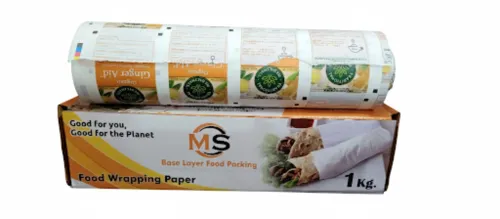
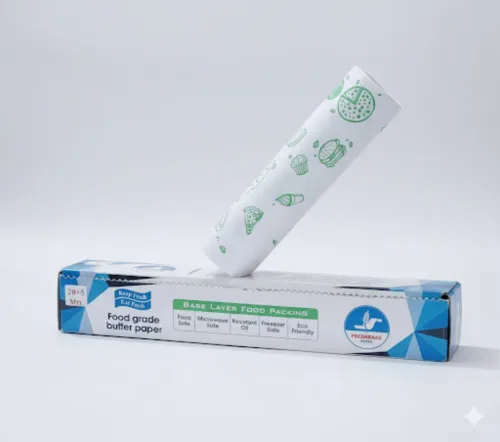
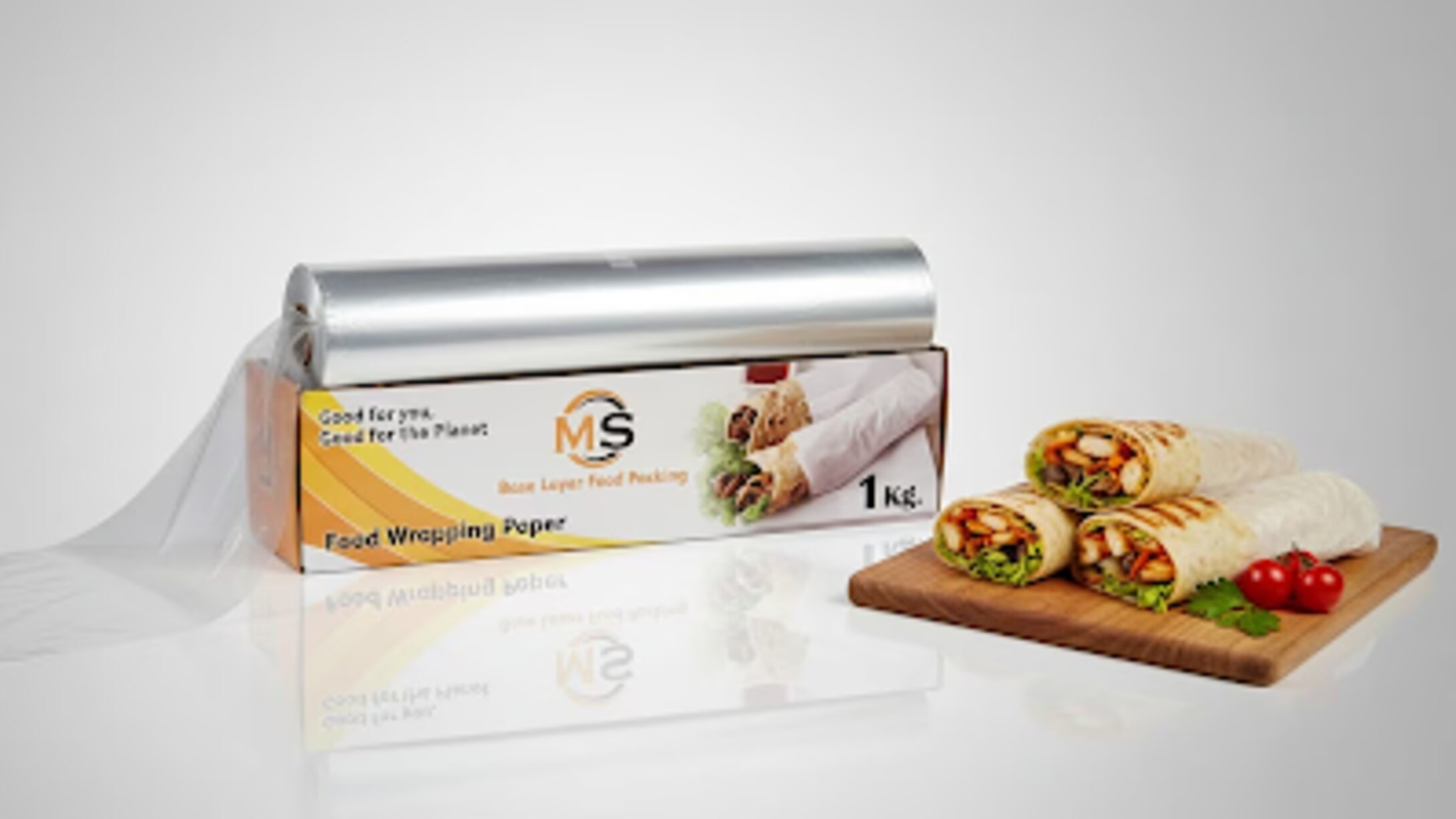
When comparing Baselayer Food Packing with another source, request lot-specific reports and samples sealed on your equipment, not generic certificates. Reject any laminate that leaks, delaminates, transfers odor or loses seal strength after the planned storage and heating cycle.
Related products
 | food packaging FOIL PAPER [ 2 In 1] (1kg net weight) Foil paper is a high-performance material that combines the strength and versatility of premium paper with the unmatched barrier properties of... View product → |
 | Food Packaging Aluminum Foil In 11 Micron 1kg Aluminum foil available in 11 micron 1kg View product → |
Make the final choice on line performance, application fit and supply controls
Choose aluminum-laminated paper only when its barrier, foldability or heat resistance solves a defined packaging problem that paper alone cannot. Approve it after a production-line trial covering unwinding, slitting, folding, sealing and end-of-roll handling; a material that performs in a sample pack but breaks, telescopes or sheds at speed is not fit for purpose.
Confirm the actual food-contact side in the specification. Bare aluminum is not automatically suitable for acidic, salty or highly moist foods. Require the supplier to identify whether paper, lacquer or polymer film contacts the food and to provide compliance for the specified food category, temperature and duration.
A generic “FDA compliant” statement does not identify the treatment, use condition or complete construction.
Make delivery control part of the award decision. Require:
- A controlled specification for alloy, temper, foil thickness, paper basis weight, laminate bond, roll width tolerance and sheet-size tolerance.
- Roll records covering core dimensions, diameter, length, winding hardness, splice construction and edge damage.
- Batch traceability from raw materials through conversion, plus a certificate of analysis for every dispatched batch.
- A change-notification rule for adhesive, coating, paper grade, foil source or manufacturing site.
- A verifiable ISO 22000 or FSSC 22000 certificate showing the correct site, scope and expiry date.
- Market-specific evidence for any recyclability claim; paper and aluminum being recyclable separately does not prove the laminate is accepted as a composite.
Reject “standard roll” wording. Record your tested limits and demand corrective action when the supplier misses them.
Frequently asked questions
How can you distinguish an aluminum foil manufacturer from a trader?
Ask for the producing mill, converting site, equipment, lot number, and process used for your order. A supplier that cannot provide these details is a trader until proven otherwise.
What material and dimensions should you specify when comparing foil suppliers?
Define the foil alloy, temper, thickness, width, roll dimensions, core size, winding direction, and permitted dimensional tolerances based on your packaging line.
What must you verify for food-contact compliance?
Check compliance for the complete laminate, including aluminum foil, paper or film layers, adhesive, inks, coatings, and the intended food-contact use.
How should you test an aluminum foil packaging supplier before choosing one?
Run samples on your production line with the intended food, checking sealing, barrier performance, adhesive bonding, machinability, roll handling, and performance after storage.
Related products
 | Food Packaging Aluminum Foil Paper [2 In 1] One Side Paper One Side Foil Foil paper available in different micron as per customer need View product → |
 | Food Packaging foil paper sheet available in customizable size as per customer requirement View product → |